
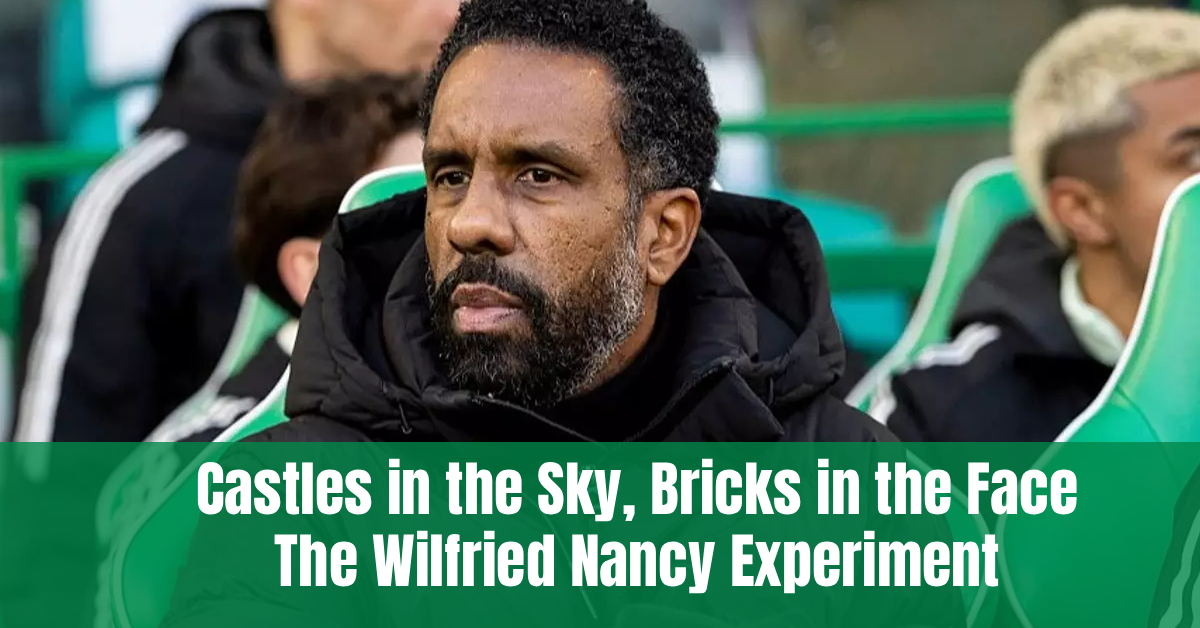
If you were trying to explain Celtic’s Wilfried Nancy era to a time traveller, you’d be done before the kettle boiled.“Right, so they sacked Rodgers, brought in Martin O’Neill to stop the bleeding, he did, then binned him for a guy on a losing run from MLS who turned out to be worse than your mate on Football Manager who picks a gegenpress and hopes for the best. Lasted eight games. Aye, tea or coffee?”
What’s staggering about the Nancy reign isn’t the catastrophe. Celtic have done catastrophe. Scottish football lives on catastrophe. It’s that nothing about it ever made sense in the first place. There was no honeymoon, no false dawn, no wee run of form you could lie to yourself about. It was pure farce from minute one, like someone had decided to turn Celtic Park into a concept art project called “What If a Superclub Was Run Like a Student Co-op?” And still charged you £600 for the privilege.
Doctor Football and the Hipster He Bought
The story really starts with Paul Tisdale, the now ex-head of football operations and self-certified “Doctor Football” – which sounds less like a job title and more like a guy who’s about to prescribe you a back three.
Tisdale arrived as the mysterious architect, the big brain in the shadows, the sort of “strategic thinker” clubs hire when they want to look modern but still sign the same left-backs from the same agents. He barely spoke to fans or media, but he did speak to the board. Sadly.
Out of that silence came Wilfried Nancy: a relative rookie, seventh in MLS, on a bad run, parachuted into a Champions League club because his vibes apparently screamed “modern football” to a man in a cashmere cardigan.
You could almost hear the pitch:
Progressive coach.
Process-driven.
Plays from the back.
PowerPoint with heatmaps.
Looks like he reads tactical blogs in French.
The problem is you can’t just copy-paste a “project coach” from the American Midwest into Glasgow and hope it goes well. MLS is the land of “We’ll play in a baseball stadium, see how it goes.” Celtic Park is the land of: “You drew with Motherwell, get out of my club.”
Tisdale sold Nancy to the board. The board bought it. The fans were told to trust “the process.” You know who never bought any of it? The Hearts support, the Motherwell support, the St Mirren support, the Dundee United support, Rangers, and, quite impressively, Celtic’s own players.
The O’Neill Contrast: One Adult in the Room
Just to really rub it in, the interim before Nancy was Martin O’Neill. Not prime-era, Euro-conquering O’Neill, but still a proper grown-up with a whistle. Eight games, seven wins. Beat Rangers in a semi-final. Skelped Feyenoord away. Clawed the gap to Hearts down to three points. Had the place feeling like a football club again rather than a tech start-up testing a beta version of “Celtic 2.0.”
Then, having watched a man restore order, the board thought: “What if we made it significantly worse, immediately?”
Nancy comes in, spends 15 minutes with O’Neill, nods politely, then essentially bins everything that had stabilised the side. It’s like moving into a perfectly functional house and deciding the first priority is to knock out three supporting walls so the place has “better energy.”
From there, the whole thing just reads like bad improv.
Hearts, Trainers, and the Tactics Board of Doom
Debut game: Hearts at home. Win, and you’re level at the top with a game in hand. So Nancy does what any rational manager would do in that position: he flips to his favoured 3-4-3, something the squad haven’t built muscle memory for, and plonks them into a high-stakes test case.
Celtic lose 2-1.
The system looks shaky. Players look unsure. The crowd looks murderous. What does Scotland focus on? His shoes and his handheld tactics board.
In fairness, if you’re going to rock green-and-white trainers at Celtic Park, you’d better either: win 4-0, or discover a new form of football.
He did neither.
The trainers vanished. The tactics board, sadly, did not.
Nancy’s post-match summary? “The performance was really interesting. Defensively, we were really good.” Hearts fans must still be laughing. Nothing screams “I don’t get this city” like telling Glasgow that a home defeat in a title race was “interesting.”
Roma, Reality, and the First Record You Don’t Want
Next up: Roma in Europe. Same shape, same chaos, different continent.
Evan Ferguson strolls around Celtic Park like he’s on a guided tour and finishes with a brace and a quote that will haunt every Nancy PowerPoint forever: he reckoned Celtic’s players “didn’t know what they were doing.”
At that point Nancy becomes the first Celtic manager ever to lose his first two games. History made, just not the type that gets you on the mural.
But we’re told: trust the process. The process, it turns out, is:
Confuse everyone.
Lose.
Tell them it was “interesting.”
Hampden: “Process” Meets St Mirren
A week later it’s the League Cup final. St Mirren at Hampden. Dream scenario for a new manager: quick trophy, confidence, bit of breathing room. Instead, we get a tactical collage. Liam Scales deciding he’s a left winger. James Forrest ending up in central midfield. Callum McGregor being dragged to the touchline repeatedly like a visiting teacher asked to calm the class.
St Mirren, who are not exactly the Harlem Globetrotters, dominate the second half as if they’ve been preparing for this moment since 1877. Celtic lose 3-1.
Nancy insists he’s “happy to be here” and accepts the challenge. The fans, to their credit, also accept the challenge: to get him sacked.
The Club That Communicates by Statement
Somewhere in the middle of all this, you remember Celtic have:
lost Brendan Rodgers,
lost John Kennedy,
lost Tisdale,
lost Nancy,
lost Peter Lawwell,
all since Hogmanay.
What they haven’t lost is their urge to hide behind short written statements while the house is on fire.
Michael Nicholson pops his head out briefly before Dundee United away to confirm the board’s backing for Nancy is “absolutely solid,” the football equivalent of saying “this relationship is really in a good place” 48 hours before splitting up and arguing over who gets the dog.
They lose 2-1 at Tannadice. That’s four defeats in a row. The “process” now resembles a slow-motion car crash being live-streamed to 60,000 people and a billion angry WhatsApps.
But fear not. The corner is coming. It always is. That’s the thing about corners in modern Celtic speak: they’re less geometric, more spiritual.
The Two-Game Revival That Fooled Nobody
Then, because football is cruelly scripted, Celtic finally look half like themselves against Aberdeen. Seventy-three percent possession. Thirty-one shots. 3-1 win. Frames rattled. People running channels like they’ve seen a training pitch before.
Nancy stands in front of the cameras and declares himself “happy for the players, happy for the fans, happy for the club, happy for the board. We chase anybody.” Two days later they go to Livingston, concede twice in eight minutes, stage a daft 4-2 comeback, and suddenly there’s this weird tension in the support: a mix of “maybe he’s actually onto something” and “aye, but it’s Livingston though.
”It’s the Just Another Defeat sweet spot: you know the disaster’s still coming, you’re just not sure what shape it’ll take.
Motherwell and the Return of Gravity
And then, Motherwell. Of course.
Askou’s lot are the most tactically coherent side in the league right now, playing neat patterns with a defensive structure that looks like it involved actual planning rather than vibes and a Pinterest board.
Celtic get run ragged at Fir Park and lose 2-0. BBC’s fan player ratings give the best Celtic performer a heroic 2.78 out of 10, which feels harsh given several of them at least remembered which way they were shooting.
Nancy, undeterred, says this “stop” will help them improve collectively. If you ever want to know whether a manager is done in Glasgow, look at the language. Once you’re talking like a mindfulness app instead of a football man, it’s over.
Rangers, Revolt, and the End
The final straw, inevitably, is Rangers. Celtic’s early-season coping mechanism was simple: “We might be bad, but look at them.” Rangers were a mess, their European campaign a blooper reel, their manager yeeted into a car boot in Falkirk figuratively if not literally.
Fast forward to the Old Firm. Danny Rohl’s Rangers have grown up. Celtic, under Nancy, have regressed to the kind of soft, brittle, anxious team that only really exists in your nightmares and, occasionally, in the East Stand’s halftime chat.
Yang Hyun-Jun scores a brilliant solo goal. The one genuine Nancy success story. Then the whole thing collapses. Youssef Chermiti, previously a punchline, helps himself to a double. Kasper Schmeichel turns into a YouTube compilation of “Goalkeeping Errors Set to Trance Classics” and fumbles Mikey Moore’s fairly tame effort into the net.
By the time the full-time whistle goes, fans are streaming out to protest at the main stand. They’ve seen enough. So have the board.
Eight games. Six defeats. Shortest reign in Celtic history. The only records broken are the ones filed under “what were we thinking?”
A Club With No Big Picture
The funniest part – if you’re neutral or your soul’s already broken – is that Nancy and Tisdale are just the most visible symptoms.
The disease is higher up. Celtic are sitting on close to [£80m] and yet: haven’t finished the stadium into a genuine 80,000-seater fortress, haven’t built the world-class museum their history easily justifies, haven’t implemented a cutting-edge scouting network worthy of their resources.
They operate like a club whose main strategic pillar is: “Stay ahead of Rangers and see what happens in Europe.” Rodgers told them that wasn’t enough. They showed him the door with all the warmth of an HMRC letter.
John Kennedy gave 27 years to the club and got a goodbye line that read like an automated unsubscribe confirmation. The question “Where’s the dignity?” is starting to sound less rhetorical by the week.
Meanwhile Hearts are being quietly turbocharged by Tony Bloom and Jamestown Analytics. Motherwell look like they’ve discovered geometry. St Mirren are lifting cups. Dundee United are coming from behind to beat the champions on a weeknight. The league is not just Celtic and Rangers’ playground anymore. Not if one of them insists on turning itself into a live-action parody of modern football.
Back to the Future (Again)
So we end where we started: with Martin O’Neill back in the dugout, wiping the whiteboard clean and telling everyone to calm down and pass to a team-mate.
It makes sense in the short term. The players will understand what they’re meant to be doing. The back three will be quietly retired to a drawer marked “never again.” Celtic will probably win more than they lose between now and May.
But there’s no getting around what this whole episode shows: this is a club that has been bobbing along on autopilot, reliant on its financial weight and domestic inertia, hoping nobody notices there’s no coherent plan behind the curtain.
They gambled on Nancy because they couldn’t imagine a world where Hearts, or anyone else, could seriously threaten their domestic hegemony. They assumed “we’re Celtic” was still a tactic. The punchline is that in trying to act like a clever, forward-thinking, data-driven club, they ended up looking like the daftest guy in the room: the one who buys the expensive gadget, throws away the instructions, and then complains when it explodes.
Is Celtic a great football club? Of course it is. Just not a particularly great football club at being run like one